The Evolution of a Brand
By Andrew Ishimaru —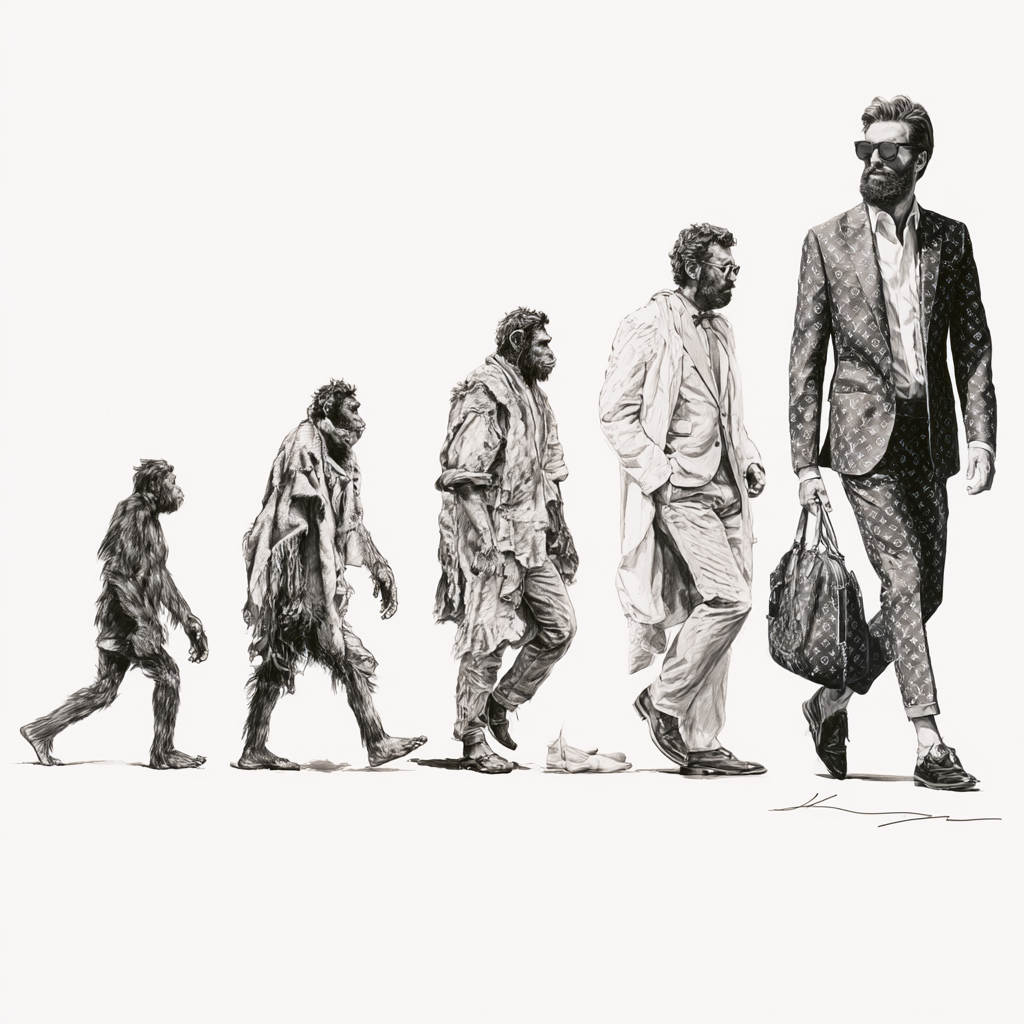
How big can a brand get? The answer today is $273 billion.
How? Why? What?
Well.
To properly understand how a brand gets that big, first we have to go all the way back to the proverbial birthplace of brands: to the bedroom, the garage, the shed out in the back of house, where brands first come to life.
The evolution of a brand begins with a spark of inspiration. Perhaps a desire to start a brand. Or a passion for clothes. For making, designing, wearing, or some other flavor of interest. It could be jewelry. It could be hats. Or handbags. It could be vintage, or futuristic, or something else entirely. Reselling shoes. Flipping archive designer. Painting. Sculpting. Saddlemaking. Creating. Any number of things could be the source of this spark.
So there is an idea, and from this origin a brand is created and the first products comes to life.
Now fast forward a bit and the brand now has an identity of its own, much like a teenager that now has its own sense of the world. People buy products. Money comes in. This is the journey from zero to the first $100k. At this point, the idea has legs. Consider an AOV of $100. That would equate to 1,000 orders – hundreds of customers assuming some repeat. It’s just enough to pay some bills after costs, but nothing crazy. Yet.
From here it’s a fast ramp up to $1m. And by fast, I mean to say that it could take years, or months. But the formula is fast. Trying new things, while doubling down on what’s working, and expanding following for the brand. Rinse and repeat. Buy product, sell it through, then place another PO. At a million a year, the brand is making real money. It’s time to go full time on it as a founder if you haven’t already. The idea is proven, it’s time to hire people full time and scale now. Consistency is the name of the game; getting into a rhythm of releasing new products, new ideas, new things every month.
The next milestone is around the $2m - $3m mark. Real money is coming in, but the brand is now a legitimate business, and that greatly increases the complexity of operations. Finances get more serious. It's not enough to just look at how much cash is in the bank account any more. Customer support is overwhelming if any one thing goes wrong. Physically shipping orders is a major effort. Many brands die here, sadly. Real company building expertise is needed to professionalize operations – but very very critically, this cannot kill the company’s creativity and speed of execution.
The teenage brand is growing up, becoming a real adult, and realizing to fulfill her destiny she needs both sides of her brain to talk to each other; the creative side that gives life to the brand, and the logical side that gives structure and stability.
Then the brand doubles again to $7m, and the next set of things breaks. Finances get way more complicated; accrual books are needed, which kicks off a whole journey into the land of proper inventory tracking and warehouse systems. New customers in Ohio trigger tax reporting requirements which were not planned. Personal tax filings span multiple states. POs reach crazy new levels; at least $500k ordered by July, then another $500k in August, to prepare for the holidays. Maybe more.
And the stakes are significantly higher for collection performance! It costs serious money just to keep the lights on – rent, payroll, inventory, R&D. The usual suspects. Cash must be carefully managed. Promo needs to lock in. And the whole system of getting killer styles in the hands of the people must be carefully orchestrated.
But. When this all gets figured out, the foundations are set to seriously scale up. $10m comes and goes just like that.
Then $15m.
Then $25m.
Then $60m.
Then $100m.
A brand can run up to the 100 barrier simply by executing the playbook that was forged from long nights back at the $7m mark – though the warehouse will definitely need to expand! Do that right and sales can double to triple every year. New product lines get introduced. Varied categories, or perhaps price points in the mix. But at the end of the day it’s all so simple – just increasing the scale of what’s working.
OK great. So the brand is sophisticated now, and $100m is in the rearview mirror. Life is good, money is coming in, and the brand becomes the culture it reflects back into the zeitgeist. She is thriving, living life, yet looking around now to see what comes next.
And that is the road to a billion.
Serious multi category expansion. One product line doing $100m by itself. Bicoastal shipping. International expansion. A whole roster of retail stores, experiential events and ideas at a global scale. London. Tokyo. Shanghai. Paris. Carte blanche to fulfill the heart’s wildest creative desires. The sky is the limit.
At this mark, you are a global name.
However, our brand is at an impasse once again. She is a celebrity. She is wealthy. She goes to the best parties and eats the best food and has the best of times with all the other famous people. Life is amazing. But now she has to decide what her legacy will be at the end of her journey in this lifetime.
The brand is now a full on corporation. There may be talk of going public, shooting for an IPO. And yet. Following the same playbook that got to a billion now yields incremental growth at best, capping out with the market.
The future is bright. But once more, uncertain.
This is where there is a fork in final path of a brand’s evolution: the path for corporate brands, and the path for holding companies.
The very best corporate brands that can stand by themselves eventually reach the $50 billion mark; as I write this, only one brand takes that crown and that is Nike, sitting at a $62 billion market cap.
Running right behind them: Adidas, Lululemon, Ralph Lauren. Hermes is there too, but it is not a corporate brand, it's something different – we will get back to Hermes in a bit.
The other, and more typical corporate path, is brand holding companies, or Groups. Inditex (Zara & others), TJX Companies (TJ Maxx & others), Fast Retailing (Uniqlo & others), VF Corporation, Authentic Brands Group, Prada Group, GIII Apparel, etc. etc.
These entities group multiple brands under their corporate umbrella and range in value from 10-figure to 12-figure valuations with top holding companies like Inditex (Zara) sitting at a market cap of $183 billion today. These companies are likely public, but may be private equity owned. They are professionally run as mega corporations and ruthlessly squeeze every cent from their supply chains.
It’s a nice sort of expected resting place for a brand, and the market will do what the market does to corporations. They exist, they make money, it's cool.
But. There is a final evolution beyond the corporate brand and holding company. This is where the final form of the brand is introduced: the fashion house.
Fashion houses are corporations too, with multiple brands under the house name. But they differ greatly from corporate holding companies in their ability to curate creativity. They are not just in the business of forecasting trends and making clothes, but also the creative business, as patrons, curators, stewards, and drivers of cultural capital.
LVMH. Hermes. Kering. The pinnacle of a brand’s evolution and some of the best businesses ever created in the history of the world, with LVMH and Hermes taking #1 and #2.
LVMH is a work of financial engineering art and a beacon of cultural capital infused brand equity, which Bernard Arnault has assembled brilliantly over his lifetime. It has a market cap today of $273 billion and is the biggest fashion company ever created, with its brands spanning multiple generations of heritage.
Individual brands in the LVMH empire by themselves have their own story, and over the years were acquired into the house by Arnault. The house was built through M&A. Leveraged buyouts. Clever use of capital markets. And a deep understanding of cultural capital. And together, they are the face of the world’s luxury market.
Hermes on the other hand is a more pure brand, with a market cap of $171 billion under one single identity. This is why it is an exception to the 'corporate brand' identity. It has transcended. Like LVMH the name commands the highest prices, the highest expectations of quality, and the most cachet per dollar.
A very, very long ways away from humble beginnings. As a fashion house, our brand, she has transcended the limits of a single lifetime. She spans multiple generations, inspiring new young creatives over the decades as a vehicle for shaping culture in the macro cycles of humanity.
And the market has decided today, it is worth $273 billion at the top.
This is the evolution of a brand.